Cervicogenic Headache: When Your Headache Comes From the Neck
Cervicogenic headache is head pain referred from a problem in the upper neck, most often the joints and nerves between C1 and C3. It is usually one-sided and tied to neck movement. It is diagnosed from the history and examination, sometimes confirmed with a nerve block; a neck MRI often looks normal or shows only age-related change, and scans are mainly used to rule out other causes.
Common Symptoms
- One-sided headache that starts at the base of the skull and spreads over the top of the head toward the eye
- Headache brought on or worsened by certain neck movements or by holding the head in one position for long
- Reduced neck rotation, especially when turning toward the side of the headache
- Tenderness over the upper neck joints or the muscles just below the back of the skull
- Pain that stays on the same side from one episode to the next rather than switching sides
- Ache in the neck, shoulder or arm on the same side as the headache
Which headache with neck pain is an emergency?
Call emergency services or go to an emergency department for a sudden, explosive headache that peaks within about a minute; headache with fever, a stiff neck, a rash or confusion; neck pain and headache after a neck injury, manipulation or a sudden twist followed by dizziness, double vision, slurred speech, face or limb numbness or weakness (possible tear of a neck artery); or any headache with new weakness, loss of balance or loss of vision. See a doctor promptly for a new headache after the age of 50, a headache that steadily worsens over weeks, pain on chewing with scalp tenderness, or headache in someone with cancer or a weakened immune system.
How can a neck problem cause a headache?
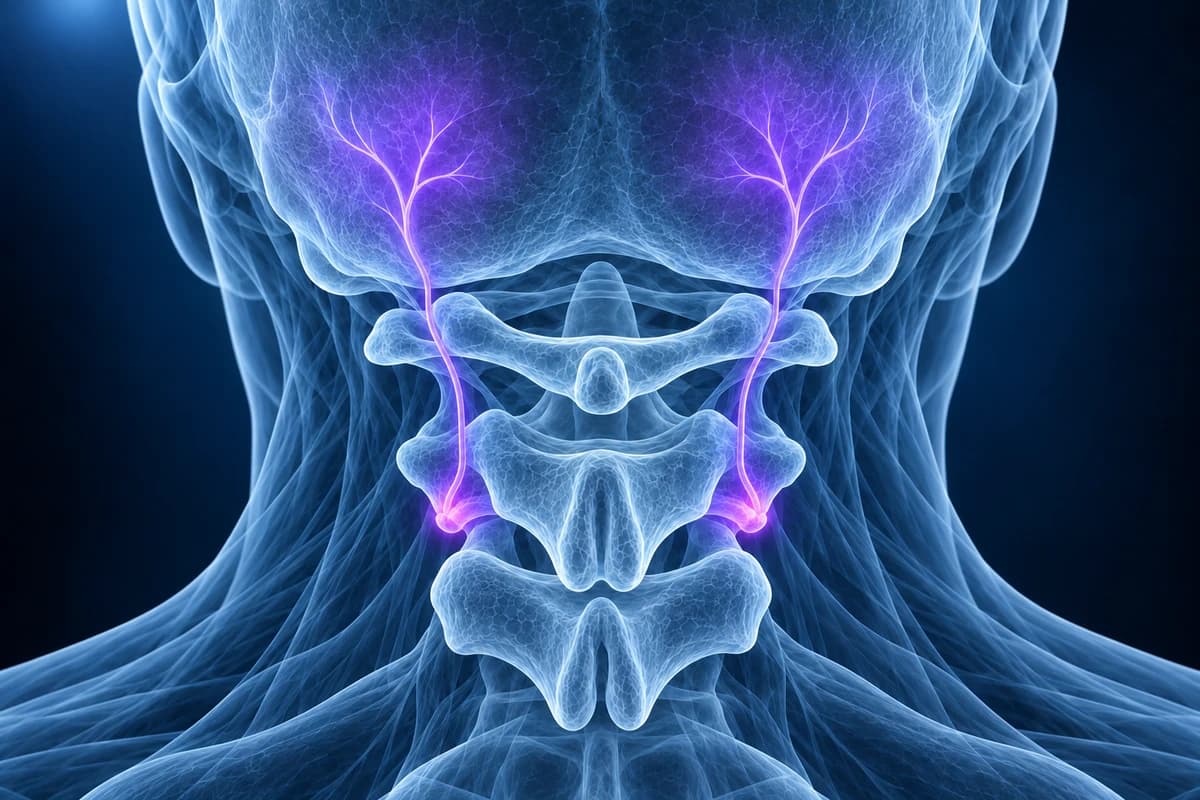
The upper three neck nerves and the trigeminal nerve, which carries sensation from the forehead and around the eye, feed into the same group of nerve cells at the top of the spinal cord, called the trigeminocervical nucleus. The brain cannot always tell which source a pain signal came from, so irritation of an upper neck joint, ligament or muscle can be felt at the back of the head, the temple or behind the eye.
The structures most often blamed are the C2–C3 facet joint, supplied by the third occipital nerve, and the joint between C1 and C2. Upper neck pain generators are common after whiplash injury, and the same mechanism explains why some people with upper neck arthritis or instability, for example atlantoaxial instability in rheumatoid arthritis, report pain at the back of the head.
How is cervicogenic headache diagnosed?
The International Classification of Headache Disorders (ICHD-3) defines cervicogenic headache as headache caused by a disorder of the cervical spine or its soft tissues. A clinical or imaging finding of a neck disorder able to cause headache is required, together with evidence that it is the cause: the headache began in step with the neck problem, improves as the neck problem improves, comes with reduced neck movement and is provoked by neck manoeuvres, or disappears after a diagnostic block of the suspected structure or its nerve. At least two of those four lines of evidence are needed.
In practice a clinician takes a careful headache history, examines neck rotation (the flexion-rotation test checks C1–C2 movement), presses on the upper joints to see whether that reproduces the familiar headache, and screens for red flags. Because many headache types cause neck pain, the diagnosis is made only when the pattern genuinely points to the neck. A controlled anaesthetic block of the third occipital nerve or the C2–C3 joint is the most specific test available, and is usually reserved for people being considered for nerve-ablation treatment.
Do you need an MRI or X-ray for cervicogenic headache?
Usually not to make the diagnosis. The ACR Appropriateness Criteria for cervical neck pain support imaging when there are red flags such as trauma, suspected infection, cancer history or neurological deficit, and treat it as often unnecessary for neck pain without them. A scan cannot show pain: the facet arthritis or disc wear it reveals is common in people with no headache at all, and a perfectly normal scan does not exclude a painful joint.
Imaging earns its place when the picture is atypical. A cervical spine X-ray, sometimes with flexion-extension views, can show upper neck instability. A cervical MRI checks for an upper cord or nerve problem, inflammatory arthritis, a tumour or infection. A brain MRI or CT and vascular imaging belong to the urgent headache pathway, not to routine neck pain. Our guide on whether you need an MRI for neck pain goes through these decision points.
What upper-neck findings on a report might be relevant?
- "C2–C3 facet arthropathy"
- Wear of the small joint at the back of the spine between C2 and C3. It is the most studied source of neck headache, but the same finding is common in people without headache.
- "Degenerative changes of the atlantoaxial joint"
- Arthritis between C1 and C2, the pivot that provides about half of neck rotation. It can cause pain at the back of the head and limited turning.
- "Increased atlanto-dental interval"
- A widened gap between the front of C1 and the peg of C2 (the dens). It signals possible instability and needs medical review rather than headache treatment alone.
- "Straightening of the cervical lordosis"
- The usual forward curve of the neck looks flatter. It is a non-specific finding often linked to muscle guarding and does not by itself prove a cause of headache.
- "Multilevel spondylosis"
- General age-related disc and joint change. Changes in the lower neck mostly explain neck and arm symptoms, not headache.
For wording not listed here, see cervical MRI report phrases explained, straightening of the cervical lordosis and cervical spondylosis.
What we look for on neck imaging for headache
- Joint wear, effusion or swelling at the C1–C2 and C2–C3 joints, compared side to side
- The gap between C1 and the dens, and any change in that gap on flexion and extension views
- Signs of inflammatory arthritis around the dens, such as erosions or soft-tissue thickening
- Cord shape and signal at the craniocervical junction
- Unexpected bone lesions, infection or soft-tissue masses that would change the diagnosis entirely
Is it cervicogenic headache, migraine or tension-type headache?
Neck pain is common during migraine attacks and in tension-type headache, so neck pain alone does not make a headache cervicogenic. Migraine usually brings throbbing pain with sensitivity to light and sound or nausea, may switch sides between attacks, and is not reliably triggered by pressing on the neck. Tension-type headache is usually on both sides and band-like. Occipital neuralgia causes brief, electric, shooting pains in the scalp rather than a steady ache. Cervicogenic headache is more often side-locked, starts in the neck, and is reproduced by neck movement or pressure over the upper joints. Some people have more than one type, which is why a headache diary helps.
What treatment helps cervicogenic headache?
First-line care is a physiotherapy programme that combines manual therapy of the upper neck with exercise for the deep neck flexor and shoulder-blade muscles, plus attention to sustained postures at work. Medicines are chosen by the treating clinician; frequent use of painkillers can itself cause medication-overuse headache, so it helps to track how often you take them.
For persistent cases, pain specialists may use diagnostic blocks of the greater occipital nerve, the third occipital nerve or the facet joints. When controlled blocks confirm the C2–C3 joint as the source, radiofrequency neurotomy of the third occipital nerve has the strongest published evidence. Surgery is rarely part of treatment unless imaging shows a structural problem such as instability.
Can I review my own neck scan?
If you already have a neck MRI or X-ray, you can open it privately in the free MRI viewer or the free X-ray viewer; nothing is uploaded. For a plain-language explanation of the report, upload your images for an AI review. It can tell you what the findings mean; it cannot tell you whether they cause your headache, and it is not a diagnosis or a substitute for your doctor.
Frequently Asked Questions
Can a neck MRI confirm cervicogenic headache?
No. MRI can show a structural problem that could cause headache and can rule out serious causes, but common findings such as facet wear appear in many people without headache. The diagnosis relies on the pattern of symptoms, the examination and, in some cases, a diagnostic nerve block.
Where is cervicogenic headache felt?
Typically on one side, starting at the back of the head or upper neck and spreading over the top of the head to the forehead, temple or around the eye. The side usually stays the same from episode to episode.
Can whiplash cause cervicogenic headache?
Yes. Headache is one of the most common symptoms after a whiplash injury, and the C2–C3 joint is a recognised source. If headache follows any neck injury, it should first be checked for fracture or artery injury; our article on what whiplash MRI shows explains the role of scanning.
Is neck manipulation safe for neck-related headache?
Manual therapy is a common part of treatment, but high-velocity manipulation of the neck carries a small risk, including injury to a neck artery. Discuss options with a qualified clinician, and seek emergency care for dizziness, speech change, vision change or weakness after any neck treatment.
Sources
- Headache Classification Committee of the International Headache Society (IHS). The International Classification of Headache Disorders, 3rd edition. Cephalalgia. 2018;38(1):1-211.
- Bogduk N, Govind J. Cervicogenic headache: an assessment of the evidence on clinical diagnosis, invasive tests, and treatment. Lancet Neurol. 2009;8(10):959-968.
- Expert Panel on Neurological Imaging; McDonald MA, Kirsch CFE, et al. ACR Appropriateness Criteria Cervical Neck Pain or Cervical Radiculopathy. J Am Coll Radiol. 2019;16(5S):S57-S76.
Related Articles
What "straightening" or "loss of the normal cervical lordosis" means on a neck X-ray or MRI, why it is common in people without pain, when the curve actually matters, and which findings deserve more attention.
Why most whiplash MRIs look normal, which injuries MRI can find (ligament tears, bone bruises, disc injury, cord contusion), what report phrases like prevertebral edema mean, and when imaging is needed after a crash.
Understand your imaging before your next appointment
MRI, X-ray or CT from a CD, folder or ZIP. A PDF report or photos of the films work too.
Free to open and preview, no account needed. An optional AI report from $10 explains your images in plain language, with questions for your doctor.
Your raw files stay on this device. Only rendered images and minimal context are sent when you request an AI report.
Medical Disclaimer: This page is for informational and educational purposes only. It does not constitute medical advice, diagnosis, or treatment. AI-generated analysis may contain errors. Always consult a qualified healthcare professional for medical decisions. Full Disclaimer