Questions to Ask Before Neck Surgery: ACDF, Disc Replacement
Questions to ask before neck surgery: does the MRI match your symptoms, ACDF vs disc replacement vs foraminotomy, recovery, adjacent levels and the real risks.
Key Takeaways
- Ask the surgeon to show the level and side on the MRI that match your symptoms and examination
- Nerve-root problems often settle without surgery; symptomatic cord compression is a different decision
- ACDF, disc replacement and posterior foraminotomy suit different locations and types of compression
- New symptoms at a level next to a fusion developed at about 2.9% per year in a long follow-up study
- Swallowing trouble is common early after front-of-neck surgery and usually improves over months
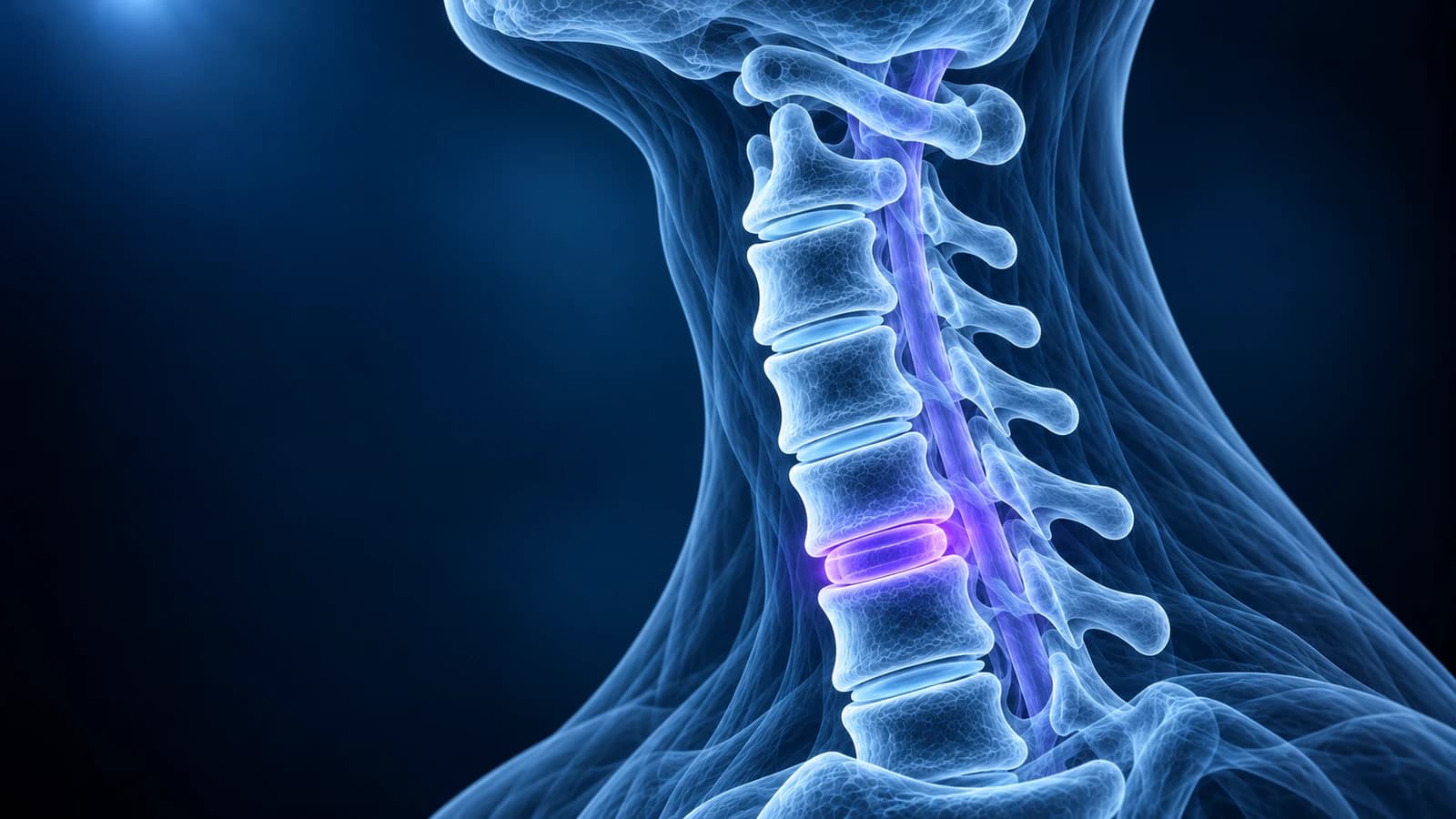
Before neck surgery, ask four things: does the MRI finding match your symptoms and examination, which operation (ACDF, cervical disc replacement or posterior foraminotomy) suits that finding and why, what recovery looks like, and how often the specific risks happen. Swallowing trouble, for example, affected half of patients at one month after front-of-neck surgery and one in eight at a year in one study.
The questions below follow the order most spine consultations take, from the scan to the decision to the months afterwards. They are not a recommendation for or against any operation; the right choice depends on an examination and on what matters to you. Take the list, your MRI report and a short note of the symptoms that limit you most.
Which symptoms should not wait for a planned consultation?
If you are on a waiting list, seek prompt medical care rather than holding on for the appointment when you notice weakness that is getting worse, clumsy hands or dropping things, a new unsteady walk, symptoms spreading to both arms or the legs, or a change in bladder or bowel control. These can mean the spinal cord is under pressure and may change how urgently the team acts.
Does the finding on my MRI explain my symptoms?
This is the most important question, because adult neck MRIs almost always show something. A large study of people with no neck symptoms found disc bulging in most of them, and such findings became more common with age. Surgeons therefore look for correlation: a compressed nerve root on the same side and at the level that matches the arm pain, the numb fingers and the weak muscle found on examination. The NASS guideline suggests MRI for confirming such a correlating compressive lesion in people who have not improved with conservative care and may be candidates for treatment.
- Which level and which side do you think is causing my symptoms, and can you show me on the images?
- Does the nerve root that is pinched match the area where I feel pain, numbness or weakness?
- Are other levels on my scan also narrowed, and why are you not treating them?
- Is the problem soft disc, bony spurs, or both? A spur narrowing the nerve exit is described in cervical foraminal stenosis.
- If the scan and my symptoms do not quite agree, would a CT myelogram, a nerve conduction study or a diagnostic nerve-root injection help?
The NASS guideline suggests CT myelography when symptoms and MRI findings do not match, for example when narrowing of the nerve exit is suspected but not clearly seen. The words your report uses for each finding are decoded in cervical MRI report phrases explained.
Is the problem a pinched nerve root, the spinal cord, or both?
A pinched nerve root causes symptoms down one arm and often improves on its own, so surgery for it is usually about relief of pain or weakness that has not settled. Pressure on the spinal cord with symptoms such as clumsy hands or a changed walk is a different decision. An AO Spine guideline recommends surgery for moderate and severe cervical myelopathy, suggests either surgery or supervised rehabilitation for mild disease, and advises against operating preventively on cord compression that causes no symptoms, with follow-up and education instead.
- Do I have radiculopathy, myelopathy or both, and how did you decide from the examination?
- Is the cord compressed on my MRI, and is there a bright signal change inside it?
- If my myelopathy is mild, what would non-operative care and follow-up look like instead?
- Is the operation meant to improve my symptoms or mainly to stop them getting worse?
That last question matters for expectations. When the cord is the target, surgery is often aimed at halting decline, and nerve function that has already been lost may come back only partly. Narrowing of the whole canal over several levels is explained in cervical spinal stenosis.
ACDF, disc replacement or posterior foraminotomy: which one and why?
Three operations are commonly discussed for a pinched nerve root at one level. Anterior cervical discectomy and fusion (ACDF) goes in through the front of the neck, removes the disc and whatever presses on the nerve or cord, and fills the space with a spacer or bone graft so the two vertebrae grow into one, usually held with a small plate. Cervical disc replacement uses the same front approach but puts a moving artificial disc in the gap instead of fusing it. A posterior foraminotomy works from the back of the neck, removing a little bone and, where needed, disc fragment to widen the opening where one nerve root leaves the spine, without fusing anything.
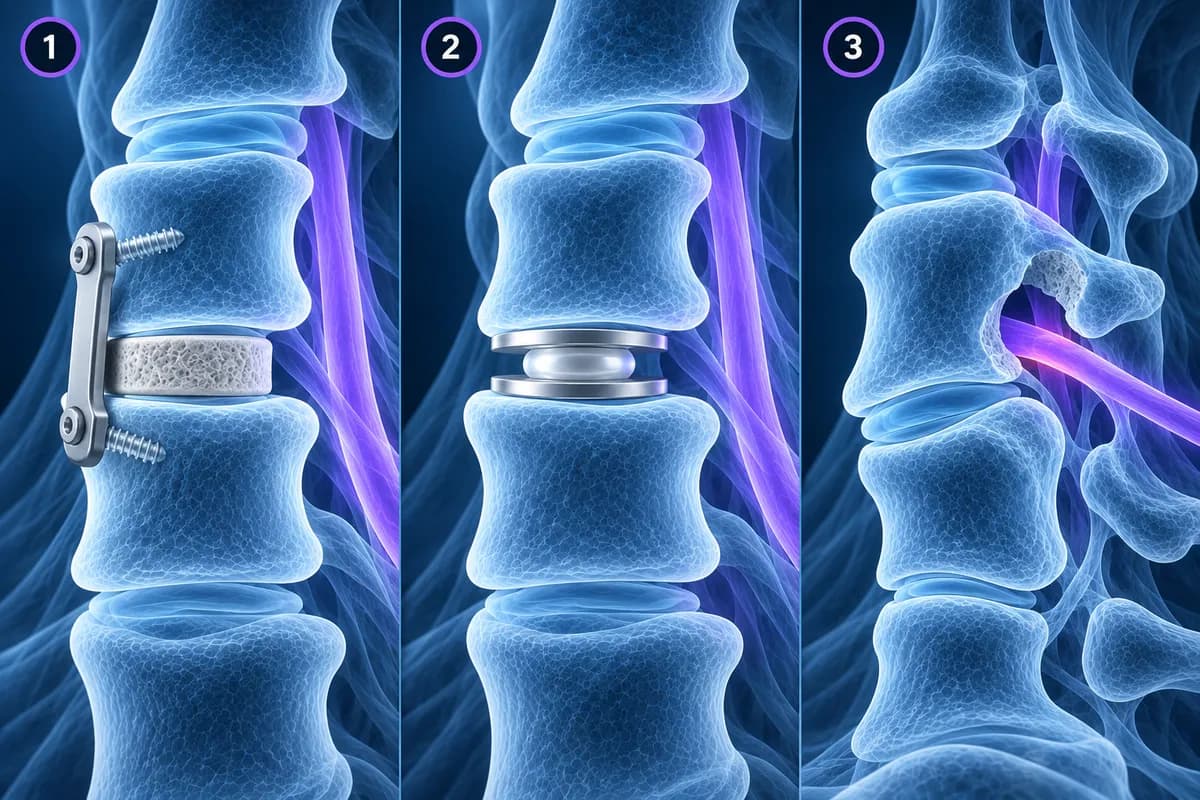
The NASS guideline rates ACDF and disc replacement as comparable for single-level radiculopathy in the short term, and rates ACDF and posterior foraminotomy as comparable when a soft disc fragment sits out in the nerve exit. For compression nearer the middle of the canal, or from spondylotic spurs, it suggests ACDF over foraminotomy. A 2022 meta-analysis of seven studies found similar pain and disability scores after minimally invasive foraminotomy and ACDF in one-sided radiculopathy without myelopathy, with a shorter hospital stay after foraminotomy.
- Where exactly is the compression: in the nerve exit, near the middle of the canal, or both?
- Would you consider a disc replacement for me, and if not, what rules it out in my neck?
- Could a posterior foraminotomy treat my problem without a fusion, and what are its drawbacks for me?
- How many levels would you include, and why that number?
- How many of this operation do you do each year, and what are your own results?
When is surgery from the back of the neck discussed for myelopathy?
When the cord is squeezed over several levels, for example by a long band of thickened ligament or by narrowing that runs from C3 to C6, surgeons may discuss a posterior operation. A laminoplasty hinges the back of the canal open to give the cord room while preserving some movement; a laminectomy removes the back arch and is often combined with a fusion using rods and screws. Front, back and combined approaches each have a place, and the choice depends on how many levels are involved, the curve of the neck and where the pressure comes from.
- Why front, back or both for my neck, and how does the curve of my neck affect that choice?
- Will the operation keep any movement, or will several levels be fused?
- Which risks are specific to the approach you are recommending?
What is adjacent-segment disease, and does a disc replacement prevent it?
After a fusion, the discs just above and below the fused level keep ageing and may wear faster. In a long follow-up of 374 patients after anterior cervical fusion, new nerve or cord symptoms from an adjacent level appeared at about 2.9% per year, and an estimated 25.6% had developed them within ten years. The C5–C6 and C6–C7 levels carried the greatest risk. The same authors concluded that the natural progression of spondylosis likely plays a major part.
Disc replacement was designed to reduce this by keeping the level moving. A 2022 meta-analysis of 19 randomised trials found adjacent-segment degeneration on imaging in 6.1% after ACDF and 3.1% after disc replacement, with lower rates of related reoperation too, while calling for longer studies. What a scan after fusion shows at the neighbouring levels is covered in cervical MRI after fusion.
- Do the levels next to my problem level already show wear on the MRI?
- How likely is it that I will need another operation on a neighbouring level?
- If you would use a disc replacement, how long has that implant been followed in studies?
What are the risks, in plain words?
Front-of-neck operations move the gullet and windpipe gently to one side to reach the spine, which explains the commonest complaint afterwards. In a prospective study of 249 patients after anterior cervical surgery, difficulty swallowing was reported by 50.2% at one month, 32.2% at two months, 17.8% at six months and 12.5% at twelve months; only 4.8% had moderate or severe trouble at six months. Weakness of a vocal cord, which can make the voice hoarse, was found in 1.3% at a year.
- Swallowing and voice: how often do your patients have trouble swallowing or a hoarse voice, and how long does it usually last?
- Nonunion: after a fusion, what if the bones do not join? Ask whether smoking or the number of levels changes my risk, and how it would be found.
- Nerve and cord: what is the chance my arm symptoms do not improve, or that a nerve or the cord is injured?
- Bleeding, infection and wound problems: what are the warning signs in the first days?
- Back-of-neck approach: what neck pain and muscle stiffness should I expect, and for how long?
Ask for numbers from the surgeon’s own practice where possible, and ask which symptoms after discharge mean calling straight away. New difficulty breathing, rapidly increasing neck swelling or new weakness in the arms or legs after surgery need emergency care.
What will recovery look like, and what happens if I wait?
- How long will I be in hospital, and will I need a collar afterwards?
- When can I drive, return to a desk job, return to manual work and lift again?
- Which symptoms usually improve first, and which may stay?
- Will I have physiotherapy, and when will the first follow-up X-ray be?
- What is likely to happen to my symptoms if I choose not to have surgery now?
The answer to the last question is often reassuring for arm-pain problems. The NASS guideline suggests that surgery gives faster relief of radiculopathy than non-operative treatment, while noting that in the randomised trial it reviewed the results were similar at one year. How a disc herniation in the neck usually behaves without an operation is set out in our neck herniated disc recovery timeline.
How can I look at my own neck MRI before the appointment?
Open the study in our free MRI viewer, which runs in your browser and keeps the files on your device. Find the level named in the report on the side (sagittal) images, then scroll the top-down (axial) slices at that level to see the cord and the two nerve exits. Screenshots of what you want explained make the consultation faster. The guide to reading a cervical spine MRI walks through the sequences.
What does ACR guidance cover when neck pain is first assessed?
ACR neck-pain guidance describes which scenarios usually warrant imaging when neck pain is first assessed; ask your surgeon which one fits you. For chronic radiculopathy without trauma or red flags, MRI without contrast is usually appropriate; chronic neck pain without radiculopathy or red flags may be assessed with X-rays or non-contrast MRI.
Frequently Asked Questions
Is ACDF or disc replacement better?
Neither is better for everyone. For single-level radiculopathy the NASS guideline rates short-term results as comparable, and trials report less adjacent-level degeneration after disc replacement. Disc replacement was first studied in necks without marked facet-joint arthritis, severe disc collapse or a reversed curve, and its use outside those limits is still being studied, so ask your surgeon which option fits your images and why.
Do I need a new MRI before neck surgery?
Often, if the last scan is old or your symptoms have changed since it was taken, because the operation is planned on the level and type of compression. Surgeons decide this case by case; ask whether your current images are recent enough.
Will neck surgery fix my neck pain as well as my arm pain?
Operations for a pinched nerve are aimed mainly at arm symptoms. Neck pain may improve too, but it has many causes and is less predictable, so ask the surgeon which of your symptoms they expect the operation to help.
Can I get a second opinion before neck surgery?
Yes, and for a planned operation it is common and reasonable. Bring the actual images on disc or by download, not only the written report, so the second surgeon can judge the correlation with your symptoms themselves.
Can AI tell me which neck operation I need?
No. An AI explanation can translate your MRI report and help you write questions, but it is not a diagnosis and cannot examine your reflexes, strength or walking. The choice of operation, or of no operation, is made between you and your surgeon.
Sources
- Bono CM, Ghiselli G, Gilbert TJ, et al. An evidence-based clinical guideline for the diagnosis and treatment of cervical radiculopathy from degenerative disorders. Spine J. 2011;11(1):64-72.
- Fehlings MG, Tetreault LA, Riew KD, et al. A Clinical Practice Guideline for the Management of Patients With Degenerative Cervical Myelopathy: Recommendations for Patients With Mild, Moderate, and Severe Disease and Nonmyelopathic Patients With Evidence of Cord Compression. Global Spine J. 2017;7(3 Suppl):70S-83S.
- Nakashima H, Yukawa Y, Suda K, et al. Abnormal findings on magnetic resonance images of the cervical spines in 1211 asymptomatic subjects. Spine (Phila Pa 1976). 2015;40(6):392-398.
- Zou T, Wang PC, Chen H, Feng XM, Sun HH. Minimally invasive posterior cervical foraminotomy versus anterior cervical discectomy and fusion for cervical radiculopathy: a meta-analysis. Neurosurg Rev. 2022;45(6):3609-3618.
- Hilibrand AS, Carlson GD, Palumbo MA, Jones PK, Bohlman HH. Radiculopathy and myelopathy at segments adjacent to the site of a previous anterior cervical arthrodesis. J Bone Joint Surg Am. 1999;81(4):519-528.
- Toci GR, Canseco JA, Patel PD, et al. The Incidence of Adjacent Segment Pathology After Cervical Disc Arthroplasty Compared with Anterior Cervical Discectomy and Fusion: A Systematic Review and Meta-Analysis of Randomized Clinical Trials. World Neurosurg. 2022;160:e537-e548.
- Bazaz R, Lee MJ, Yoo JU. Incidence of dysphagia after anterior cervical spine surgery: a prospective study. Spine (Phila Pa 1976). 2002;27(22):2453-2458.
- Divi SN, Plantz MA, Tegethoff J, Su BW. Current and Expanded Indications for Cervical Disc Arthroplasty: Beyond the FDA IDE Studies. Clin Spine Surg. 2023;36(9):375-385.
Related Articles
What an MRI can and cannot show after an anterior cervical fusion (ACDF): metal artifact, adjacent segment disease, residual compression and cord signal, when CT or X-ray answers better, and which symptoms need urgent care.
How a herniated disc in the neck recovers phase by phase, how often herniations shrink on their own, when a repeat MRI helps, and which signs change the plan.
What your neck MRI report means: uncovertebral hypertrophy, foraminal narrowing grades, effacement of the CSF, cord flattening, T2 hyperintense cord signal, Modic changes and more, each explained in one or two plain sentences.
Related Conditions
Understand your imaging before your next appointment
MRI, X-ray or CT from a CD, folder or ZIP. A PDF report or photos of the films work too.
Free to open and preview, no account needed. An optional AI report from $10 explains your images in plain language, with questions for your doctor.
Your raw files stay on this device. Only rendered images and minimal context are sent when you request an AI report.
Medical Disclaimer: This page is for informational and educational purposes only. It does not constitute medical advice, diagnosis, or treatment. AI-generated analysis may contain errors. Always consult a qualified healthcare professional for medical decisions. Full Disclaimer