
Cervical MRI Cost: What Sets the Price of a Neck MRI
What sets the price of a cervical spine MRI: hospital or imaging centre, contrast (CPT 72141 vs 72156), 1.5T or 3T, insurance, prior authorisation and cash pay.
Key Takeaways
- A neck MRI price depends mainly on the facility, the use of contrast, your insurance terms and your region
- CPT 72141 is the plain cervical MRI; 72156 adds contrast and further sequences and is priced higher
- Most neck MRIs for pain or a pinched nerve do not need contrast
- 1.5T and 3T scans share the same code, so magnet strength rarely drives the bill
- Prior authorisation and a written good faith estimate protect you from surprise charges
A cervical spine MRI has no single price. What you pay is set mainly by four things: whether the scan is done in a hospital department or an independent imaging centre, whether contrast is used (billed as CPT 72141 without contrast or 72156 without and then with contrast), your insurance terms, and where you live. Magnet strength, 1.5T or 3T, matters much less to the bill.
This guide does not quote dollar figures, because we could not find a published, verifiable price study specific to neck MRI, and generic averages hide a very wide spread. Instead it explains each lever on the price, where to look up real numbers for your own scan, and the questions that save the most money before you book. It is general information about billing and imaging, not medical or financial advice.
How much does a cervical spine MRI cost?
Every neck MRI has two parts on the bill, even when they arrive as one invoice. The technical part pays for the scanner, the room, the technologist and, where used, the contrast agent. The professional part pays the radiologist who reads the images and writes the report. Medicare lists the two separately in its physician fee schedule, and a hospital may send them as two bills from two organisations.
On top of that split sit three different prices for the same scan. The negotiated rate is what your insurer has agreed to pay the facility. Your share is what is left for you after the deductible, copay or coinsurance is applied to that rate. The cash or self-pay price is what the facility charges someone paying directly, and it is often a bundled figure that differs from both. When you compare quotes, make sure you are comparing the same one of the three.
In the United States, two public tools help you find real numbers. Hospitals must publish their standard charges, including payer-specific negotiated rates and discounted cash prices, under the federal hospital price transparency rule. Medicare's fee schedule search shows what Medicare pays for a code in your locality, which is a useful floor when you negotiate a cash price. Outside the US, the price depends on your public system, private insurer and waiting list rather than on these codes.
What do CPT codes 72141, 72142 and 72156 mean on a neck MRI bill?
US bills describe the scan with a procedure code, and the code is the single biggest driver of the price you are quoted. Three codes cover the cervical spine:
- 72141 — MRI of the cervical spinal canal and contents without contrast. This is the standard study for neck pain, a pinched nerve or suspected cord compression.
- 72142 — the same region with contrast only. It is uncommon on its own, because most contrast questions need the plain pictures too.
- 72156 — without contrast, followed by contrast and further sequences. This combined study takes longer, uses an injection, and is priced higher than 72141.
Each region of the spine is its own exam with its own code. A referral that asks for the neck and the lower back is two studies and usually two charges, even if they happen in one visit. If your symptoms are really in the lower back, the scan you need is a lumbar MRI, which we explain in how to read a spine MRI. Ask the facility which code they will bill and check it matches the referral before the appointment.
Does a neck MRI with contrast cost more?
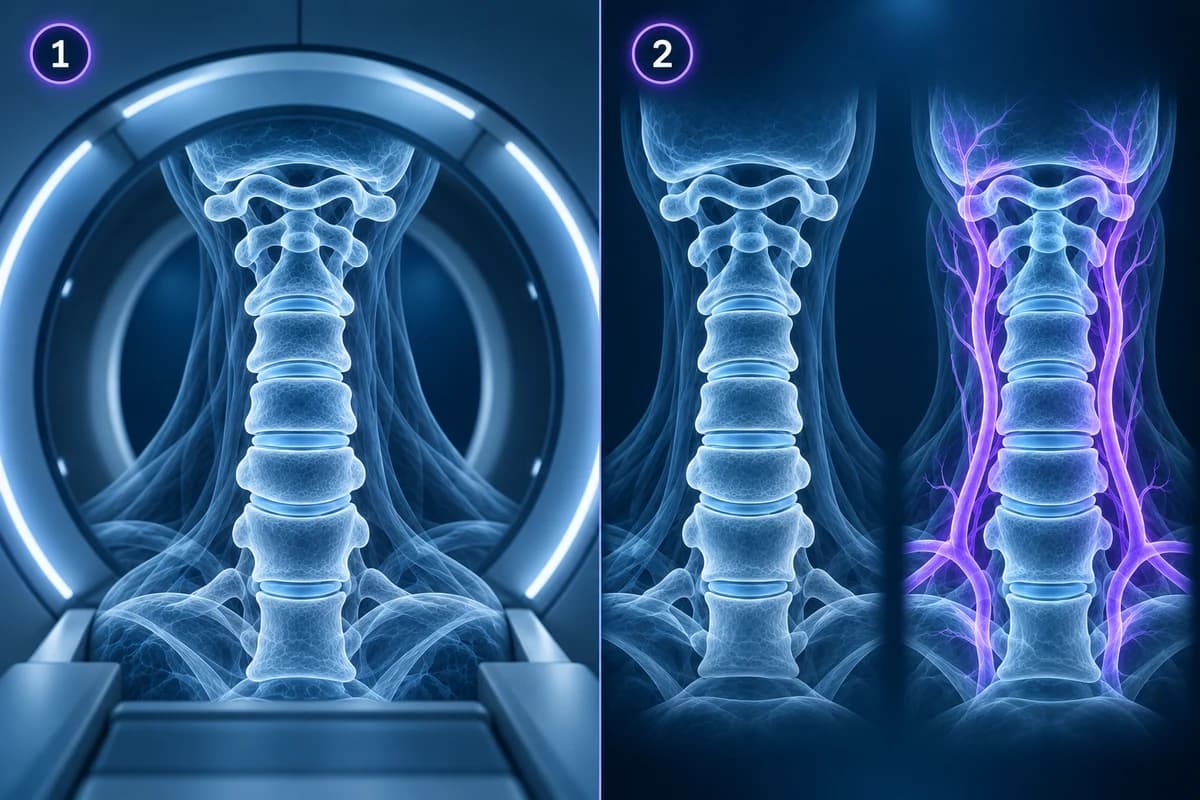
Yes. A contrast study means a cannula, a gadolinium injection, a second set of sequences after it and more time on the table, and the combined code pays more than the plain one. The good news is that most neck MRIs do not need it. Disc herniations, worn joints, narrowed nerve openings and pressure on the cord all show on the plain scan, which is why the American College of Radiology rates MRI without contrast as usually appropriate for chronic neck pain with arm symptoms.
Contrast earns its cost when the question is infection, a tumour or cancer spread, an inflammatory condition of the cord, or scar tissue versus a new disc fragment after surgery. For suspected infection and known cancer, the same ACR criteria rate MRI without and with contrast as usually appropriate. If your referral says “with contrast” and none of those questions applies to you, ask why before you book; if one does, such as a suspected disc space infection, the extra pass is worth it. Our guide to neck MRI with vs without contrast covers the medical reasons in detail.
Is a cervical MRI cheaper at an imaging centre than at a hospital?
Often, for a planned outpatient scan. Hospital outpatient departments can add a facility fee that covers the costs of running a hospital around the clock, while an independent imaging centre usually bills one global charge for the scan and the read. The same code on the same type of scanner can therefore carry very different prices a few streets apart. Hospital-based imaging still makes sense when you need sedation, an inpatient bed, an urgent slot, or a team that will act on the result the same day.
Region matters as well. Prices follow local wages, rents, market competition and which insurers a facility has contracts with, so a city with many independent centres tends to offer more room to shop than a town with one hospital scanner. Whatever you choose, check that the facility is accredited for MRI and that the report will be read by a radiologist, ideally one who reads spine studies regularly.
Does a 3T neck MRI cost more than a 1.5T scan?
Usually not by much, and sometimes not at all. The CPT code describes the body region and the use of contrast, not the magnet strength, so a 1.5T and a 3T cervical MRI are billed under the same code. Any difference comes from the facility's own pricing rather than from the coding system.
Clinically, a 3T magnet can show small nerve roots and fine detail more sharply, while a modern 1.5T scanner with a good spine coil answers the everyday questions about discs, nerve openings and the cord well. A 1.5T scanner can also be the better choice if you have certain metal implants, because some devices are only approved at the lower strength. Image quality depends heavily on the protocol and on how still you can lie, so paying extra for 3T alone rarely changes the answer for routine neck pain.
Will insurance cover a cervical MRI, and why is prior authorisation needed?
Most plans cover a neck MRI when it is medically necessary, but many require prior authorisation, a review before the scan that checks the request against imaging guidelines. Reviewers commonly look for nerve or cord symptoms, red flags such as fever, cancer history or trauma, or pain that has not settled with a period of conservative care. Plain neck pain without those features is the request most likely to be refused, because guidelines do not recommend MRI as the first test for it.
If authorisation is refused, ask the ordering clinician what the reviewer needed. Often it is documentation of arm symptoms in a nerve-root pattern, as in cervical radiculopathy, examination findings that suggest cervical myelopathy, or the dates and results of treatment already tried. Some plans also want a recent cervical spine X-ray first, which is cheap and sometimes answers the question on its own.
What if you pay cash for a neck MRI?
Paying directly can be simpler than using a high-deductible plan, especially at independent centres that publish a flat self-pay price. In the US, if you are uninsured or not using insurance and you schedule at least three business days ahead, the provider usually has to give you a written good faith estimate of the expected charges, and that estimate is what lets you dispute a bill that comes in much higher.
Before you pay, confirm in writing that the price includes the radiologist's report, that it is for the code on your referral, and that a copy of the images on disc or download is included. Paying cash does not always count toward your deductible, so if you expect more care this year, ask your insurer how a self-pay scan is treated.
How can you lower the cost of a cervical MRI?
- Ask the ordering clinician whether contrast is truly needed, and which code the referral will carry
- Get quotes from at least one independent imaging centre and one hospital for the same code
- Ask whether the quote is the negotiated rate, your estimated share, or a bundled self-pay price
- Confirm prior authorisation is approved before the scan date, so the claim is not denied afterwards
- Bring or request earlier neck imaging, so a repeat scan is not ordered just to compare
That last point is easy to overlook. If you already have a cervical MRI from another facility, ask for the DICOM files and the report. You can check what the earlier study covered in the free MRI viewer, which opens the files in your browser without uploading them, and hand the disc to the new clinician so they can decide whether a fresh scan is needed at all.
Do you need a cervical MRI at all?
The cheapest scan is the one you do not need. For new neck pain without arm symptoms, injury or red flags, the ACR criteria rate MRI as usually not appropriate as a first test, and an X-ray may be considered instead. Many episodes settle with time and movement. Our guide do you need an MRI for neck pain walks through when imaging changes the plan, and neck X-ray vs CT vs MRI explains which test answers which question.
An MRI is worth paying for when arm pain, numbness or weakness persists, when there are signs of pressure on the spinal cord, when infection or cancer is a concern, or when an injection or operation is being planned and the exact level matters.
When should cost not delay a neck scan?
Do not shop around if neck pain comes with any of the following. Seek same-day care, or emergency care if symptoms are severe or sudden, and let the treating team choose the test.
- Clumsy hands, dropping things or a new unsteady walk
- Arm or hand weakness that is getting worse
- New trouble controlling the bladder or bowel
- Neck pain after a fall, a road collision or a diving accident
- Fever or chills with neck pain, or a history of cancer with new, constant pain
Frequently Asked Questions
How much does a cervical MRI cost without insurance?
It varies widely by facility and region, and hospital list prices are often higher than the flat self-pay prices independent imaging centres advertise. Ask two or three accredited centres for a written bundled price for CPT 72141 that includes the radiologist's report, and use Medicare's published rate for your area as a reference point when you negotiate.
What is the CPT code for a cervical MRI without contrast?
72141. A cervical MRI with contrast only is 72142, and a study done without contrast and then repeated after a contrast injection is 72156. A lumbar or thoracic MRI uses different codes, so a scan of more than one spine region is billed as more than one exam.
Why did my insurer deny my neck MRI?
Denials usually mean the request did not show what the plan's guidelines look for: nerve or cord symptoms, red flags, or pain that has not improved with treatment. Ask your clinician to resubmit with the examination findings and treatment dates, or to request a peer-to-peer review with the insurer's doctor.
Is the radiologist's fee included in the MRI price?
Not always. Many independent centres quote a global price that includes the read, while hospitals often bill the scan and the radiologist's interpretation separately. Ask whether a quote is global or technical only, so a second bill does not surprise you.
How long does a cervical MRI take?
A plain study is the shorter appointment, and a contrast study adds time for the cannula, the injection and the second set of sequences, so ask the facility for its usual table time. Lying still matters more than anything else for sharp images, so mention neck pain or claustrophobia to the technologist before the scan begins.
Sources
- Expert Panel on Neurological Imaging; Eldaya RW, Parsons MS, Hutchins TA, et al. ACR Appropriateness Criteria Cervical Pain or Cervical Radiculopathy: 2024 Update. J Am Coll Radiol. 2025;22(5S):S136-S162.
- Centers for Medicare & Medicaid Services. Hospital Price Transparency.
- Centers for Medicare & Medicaid Services. Search the Physician Fee Schedule.
- Centers for Medicare & Medicaid Services. What is a good faith health insurance estimate?
Related Articles
When a cervical MRI needs gadolinium (infection, tumour, scar after surgery, MS) and when it does not, plus kidney, retention, allergy and pregnancy safety.
Most neck pain does not need an MRI. Learn the warning signs that do call for imaging, why X-ray or CT comes first after an injury, and how to read the age-related findings a neck MRI almost always shows.
Which neck scan comes first: X-ray or none for routine pain, MRI for a pinched nerve or cord signs, CT after injury under the NEXUS and Canadian C-spine rules.
Understand your imaging before your next appointment
MRI, X-ray or CT from a CD, folder or ZIP. A PDF report or photos of the films work too.
Free to open and preview, no account needed. An optional AI report from $10 explains your images in plain language, with questions for your doctor.
Your raw files stay on this device. Only rendered images and minimal context are sent when you request an AI report.
Medical Disclaimer: This page is for informational and educational purposes only. It does not constitute medical advice, diagnosis, or treatment. AI-generated analysis may contain errors. Always consult a qualified healthcare professional for medical decisions. Full Disclaimer